
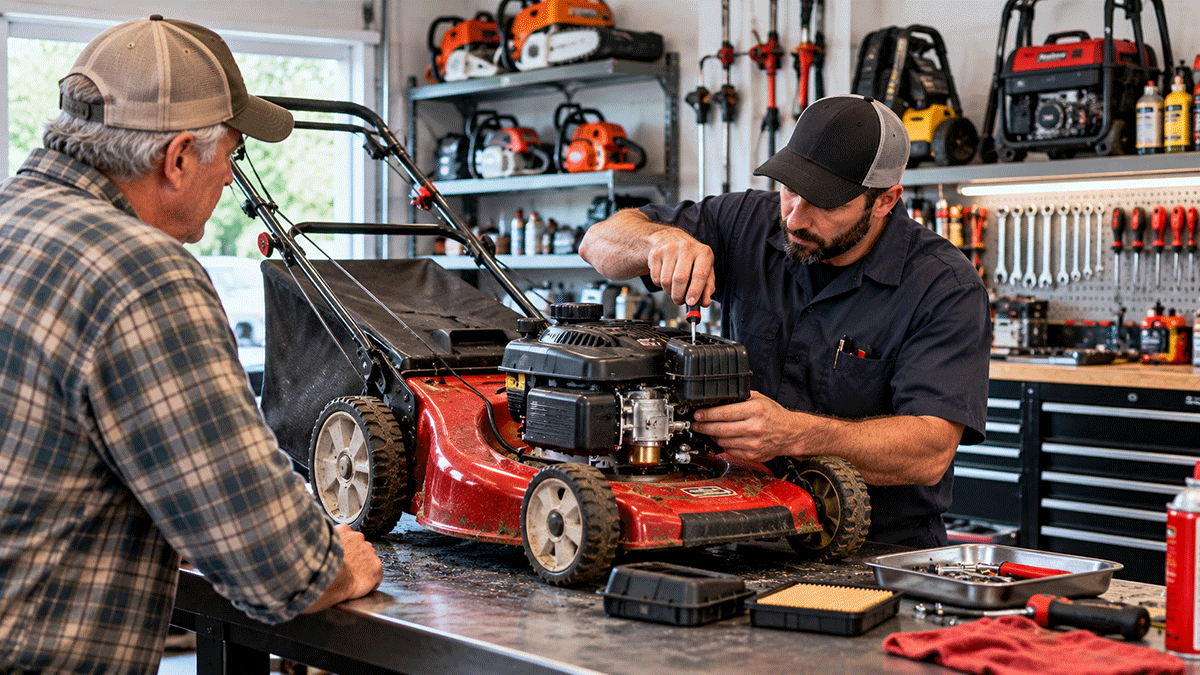
Managing a Small Engine Repair Shop Without Complicated Software

Running a small engine repair shop involves much more than diagnosing mechanical problems and replacing worn components. Every repair begins with a customer, a piece of equipment, and a problem that needs to be documented, tracked, and resolved.
Whether a shop repairs lawn mowers, chainsaws, generators, pressure washers, or other gasoline-powered equipment, keeping accurate customer and repair records is essential to providing dependable service.
WorkOrder by Local Service Rep provides small repair businesses with a practical way to organize customer information, equipment records, repair activity, and billing without the complexity often associated with larger repair management systems.
Let’s examine how a typical independent small engine repair shop can use WorkOrder to manage its daily operations.
Meet the Business: An Independent Small Engine Repair Shop
Imagine a small engine repair business called Coastal Small Engine Repair. This fictional business operates from a single workshop and serves homeowners, landscaping contractors, property maintenance companies, and other local businesses.
The shop has an owner who also performs repairs, two additional technicians, and a part-time employee who handles customer intake and administrative tasks.
Its services include:
- Walk-behind and riding lawn mower repair
- Chainsaw maintenance and repair
- Portable generator diagnostics and repair
- Pressure washer maintenance
- String trimmer and leaf blower repair
- Carburetor cleaning and replacement
- Engine tune-ups and preventative maintenance
- Replacement of belts, blades, filters, spark plugs, and other components
Most customers bring their equipment directly to the shop. Some commercial customers arrange delivery of multiple machines requiring maintenance or repair.
Unlike a field-service business that sends technicians to customer locations, Coastal Small Engine Repair performs most of its work at a central repair facility.
This makes equipment intake, repair documentation, technician assignments, replacement parts, and customer pickup important parts of the business workflow.
The Challenges of Managing a Small Engine Repair Shop
Keeping Track of Customer Equipment
On a busy Monday morning during the spring mowing season, several customers arrive with equipment requiring service.
One customer brings in a lawn mower that will not start. Another drops off a chainsaw that stalls under load. A landscaping contractor delivers two string trimmers and a leaf blower requiring maintenance.
Each repair involves different equipment, reported symptoms, replacement components, and customer expectations.
Without an organized repair management system, customer information and repair details may be scattered across handwritten intake forms, spreadsheets, equipment tags, and individual employee records.
Managing Seasonal Repair Volume
Small engine repair businesses frequently experience seasonal changes in demand.
Spring brings lawn mower tune-ups and repairs. Summer increases demand for landscaping equipment maintenance. Fall may generate chainsaw and leaf blower repairs, while portable generators often require attention before or after major storms.
During busy periods, equipment can accumulate quickly in the workshop.
Employees need to know which repairs are awaiting diagnosis, which require replacement parts, and which are ready for customer pickup.
Without consistent documentation, managing this workload becomes increasingly difficult.
Recording Replacement Parts and Labor
Small engine repairs frequently involve replacement parts, diagnostic charges, and technician labor.
A single repair might require a carburetor, fuel filter, spark plug, drive belt, blade, or other component.
Failing to document these charges accurately can result in incomplete invoices, forgotten billable work, and reduced profitability.
Keeping Customers Informed
Customers frequently call to ask whether their equipment is ready.
For commercial customers who depend on their equipment to operate their businesses, repair delays can be especially frustrating.
When repair information is not centralized, employees may need to interrupt technicians to determine the status of individual repairs.
These interruptions consume time and can create confusion, especially during peak repair seasons.
How WorkOrder Fits the Small Engine Repair Workflow
WorkOrder is designed to help organize the business activities associated with receiving, servicing, and returning customer equipment.
For a small engine repair shop, the basic workflow looks like this:
Customer Intake → Equipment Identification → Problem Description → Technician Assignment → Diagnosis & Repair → Record Parts & Labor → Invoice → Payment → Equipment Pickup
Let’s follow a realistic lawn mower repair from beginning to end.
Step 1: Customer Intake and Equipment Identification
A customer named Robert arrives at Coastal Small Engine Repair with a walk-behind lawn mower that will not start.
He explains that the mower operated normally at the end of the previous season but will not start after sitting in storage for several months.
The employee receiving the mower needs to document the customer, the equipment, and the reported problem.
Using WorkOrder, the shop can organize the repair around the customer’s information and the equipment requiring service.
Important information for a typical small engine repair intake includes:
- Customer name and contact information
- Equipment manufacturer and model
- Engine manufacturer and model, when applicable
- Serial number or other equipment identifier
- Customer-reported problem
- Initial equipment condition and relevant service notes
- Accessories or attachments received with the equipment
Accurate intake records help employees identify the correct equipment and understand what the customer expects the shop to investigate.
Business benefit: Customer and equipment information is organized from the beginning instead of being scattered across paper forms and equipment tags.
Step 2: Assigning the Repair
The shop owner assigns Robert’s lawn mower to the technician responsible for routine engine diagnostics and repair.
The technician reviews the reported starting problem before beginning the inspection.
Having customer and equipment information associated with the repair helps reduce unnecessary questions and makes it easier to understand the work that needs to be performed.
For a small shop handling several repairs simultaneously, an organized work order process helps employees distinguish new repairs from work already underway or completed.
Business benefit: Employees have a clearer understanding of which equipment requires attention and what work has been requested.
Step 3: Diagnosing the Problem
The technician inspects the lawn mower and performs the appropriate diagnostic procedures.
After examining the fuel system, the technician determines that old fuel has left deposits in the carburetor, restricting fuel delivery.
The technician also discovers that the spark plug is worn and should be replaced.
The diagnosis and recommended repairs are documented as part of the equipment’s service record.
Documenting the diagnosis provides a record of the problem, helps explain the recommended work to the customer, and supports accurate billing.
If Robert returns for additional maintenance in the future, the shop can refer to its previous service records rather than relying entirely on memory.
Business benefit: Repair documentation helps establish a useful history of work performed on customer equipment.
Step 4: Recording Parts and Labor
After explaining the diagnosis and obtaining Robert’s authorization, the technician cleans the carburetor, replaces the spark plug, and performs the necessary adjustments.
For this example, assume the repair involves the following charges:
- Diagnostic service: $30.00
- Replacement spark plug: $8.95
- Carburetor cleaning and repair labor: $65.00
Total before applicable taxes: $103.95
These figures are illustrative and do not represent WorkOrder’s subscription pricing or recommended small engine repair rates.
Keeping service charges associated with the repair helps the business prepare an accurate invoice and reduces the likelihood of overlooking billable work.
For a shop performing multiple repairs each day, consistent documentation can make a meaningful difference in administrative efficiency.
Business benefit: Repair charges are easier to organize and review before customer billing.
Step 5: Completing the Repair
After cleaning the carburetor and replacing the spark plug, the technician starts the mower and verifies that the engine operates properly.
The technician also checks for fuel leaks, confirms normal engine operation, and documents the completed work.
At this point, the shop has a record of the original problem, the diagnosis, the repair activity, and the associated charges.
The employee responsible for customer service can use the completed repair information to prepare for the equipment’s return.
Business benefit: Organized repair records help employees understand what was completed and what should be communicated to the customer.
Step 6: Invoicing and Payment
Robert returns to collect his lawn mower.
The shop reviews the completed repair and presents the invoice showing the diagnostic charge, replacement spark plug, and repair labor.
Robert pays the amount due, and the business records the payment.
Keeping repair documentation and billing information organized reduces the need to reconstruct charges from handwritten notes at the end of the job.
Business benefit: The shop can move from completed repair to customer billing with less administrative confusion.
Step 7: Maintaining Customer and Equipment Repair History
Several months later, Robert returns with a pressure washer requiring service.
Because he is an existing customer, the shop can reference its previous customer and repair information.
This is particularly valuable for businesses that develop long-term relationships with homeowners, landscaping contractors, and property maintenance companies.
A commercial customer may own several lawn mowers, string trimmers, chainsaws, and other pieces of equipment requiring periodic service.
Maintaining organized customer and equipment records helps the business provide consistent service as those relationships develop.
Business benefit: Customer and repair histories become useful business records rather than information that disappears when an individual repair is completed.
How WorkOrder Compares with Other Repair Shop Software
Independent small engine repair businesses have several software options, including general repair management platforms and specialized equipment dealership management systems.
Some platforms are designed for businesses that sell new equipment, maintain extensive parts inventories, manage manufacturer warranty claims, or operate multiple service departments.
These capabilities can be valuable for larger dealerships and repair operations.
However, a small independent repair shop does not necessarily need every feature available in a comprehensive dealership management system.
Software Cost
WorkOrder costs $49.95 per month.
For a small business, software subscriptions are recurring operating expenses. The difference between a focused application and a more expensive management platform can become significant over time.
For example:
- WorkOrder at $49.95 per month costs $599.40 annually.
- A competing subscription costing $75 per month totals $900 annually.
- A competing subscription costing $100 per month totals $1,200 annually.
These $75 and $100 examples are hypothetical price comparisons, not claims about current competitor subscription rates.
Before selecting software, businesses should compare current subscription prices, user limits, transaction restrictions, included features, and any additional fees.
Ease of Use
Large equipment dealership management systems may offer extensive capabilities, but those capabilities can introduce additional configuration and administrative requirements.
For a small engine repair shop, the more important question is whether employees can efficiently complete the activities they perform every day.
WorkOrder focuses on the fundamental repair business workflow: organizing customers, documenting equipment, managing repair work, recording charges, and handling billing.
Businesses should evaluate each application through a hands-on trial to determine which interface and workflow best fit their operations.
Choosing the Right Level of Software
A large equipment dealership with extensive parts inventory, equipment sales, manufacturer warranty processing, and multiple service departments may benefit from a comprehensive dealership management system.
A small independent repair shop primarily concerned with customer equipment, repair documentation, technician work, and billing may prefer a more focused application.
The goal is not to purchase the software with the longest feature list. It is to select software that supports the business without creating unnecessary expense or complexity.
What About Other Small Engine Repair Businesses?
The lawn mower repair example illustrates a workflow shared by many businesses that receive customer equipment for diagnosis and repair.
Similar operations can be found in:
- Lawn mower repair shops
- Chainsaw repair businesses
- Portable generator repair shops
- Pressure washer repair businesses
- Landscaping equipment repair shops
- Outdoor power equipment service centers
- Independent small engine repair workshops
Although the equipment differs, the underlying business process remains similar.
Customers bring equipment to a repair location, explain the problem, authorize service, and return to collect the repaired equipment.
WorkOrder is designed to help organize the administrative work supporting that process.
The Value of an Organized Small Engine Repair Business
Consider the administrative challenges Coastal Small Engine Repair faced before establishing a consistent repair management process.
Customer information was recorded in different places. Repair notes were sometimes difficult to locate. Employees interrupted technicians for status updates. Charges had to be reconstructed when preparing invoices.
By organizing customer information, equipment records, repair documentation, and billing activities, the business can establish a more consistent operating process.
Potential improvements include:
- More consistent customer and equipment intake
- Better organization of repair documentation
- Clearer visibility into repair activity
- Reduced dependence on handwritten notes
- More accurate documentation of billable work
- More organized invoicing and payment records
- Easier reference to previous customer repairs
- Better organization during seasonal repair demand
These are potential operational benefits of using an organized repair management process, not measured results from an actual WorkOrder customer.
Is WorkOrder Right for Your Small Engine Repair Shop?
WorkOrder is worth considering if your business operates primarily from a fixed repair location and receives customer equipment for diagnosis, maintenance, or repair.
It may be particularly relevant for independent shops that want to organize their operations without investing in a larger dealership management platform.
Before choosing any software, consider how your business handles customer intake, equipment identification, repair assignments, replacement parts, labor charges, invoicing, and payments.
The best application is the one that supports those daily activities reliably and fits your business’s operational requirements and budget.
Explore WorkOrder by Local Service Rep
Running a successful small engine repair shop requires technical expertise, dependable customer service, and organized business records.
WorkOrder is designed to help small repair businesses manage the administrative side of receiving, servicing, and returning customer equipment.
At $49.95 per month, WorkOrder offers a focused approach to repair business management for shops seeking an alternative to more complex systems.
Spend less time managing paperwork and more time completing repairs.
Explore WorkOrder Features & Benefits →
Browse More Business Case Studies →
Note: Coastal Small Engine Repair is a fictional business used to illustrate a typical small engine repair workflow. This case study does not represent an actual customer testimonial or measured business results.
Explore Our Software Solutions
Local Service Rep offers practical, affordable software designed to simplify everyday business operations. Explore our solutions:
- ServiceRep – Service business management.
- WorkOrder – Work order and repair management.
- TimeBilling – Time tracking and client billing.
- TimeClock – Employee time tracking.
- DecaVault – Personal information and record management.
Developed by Rock Local Media Group, Inc.