
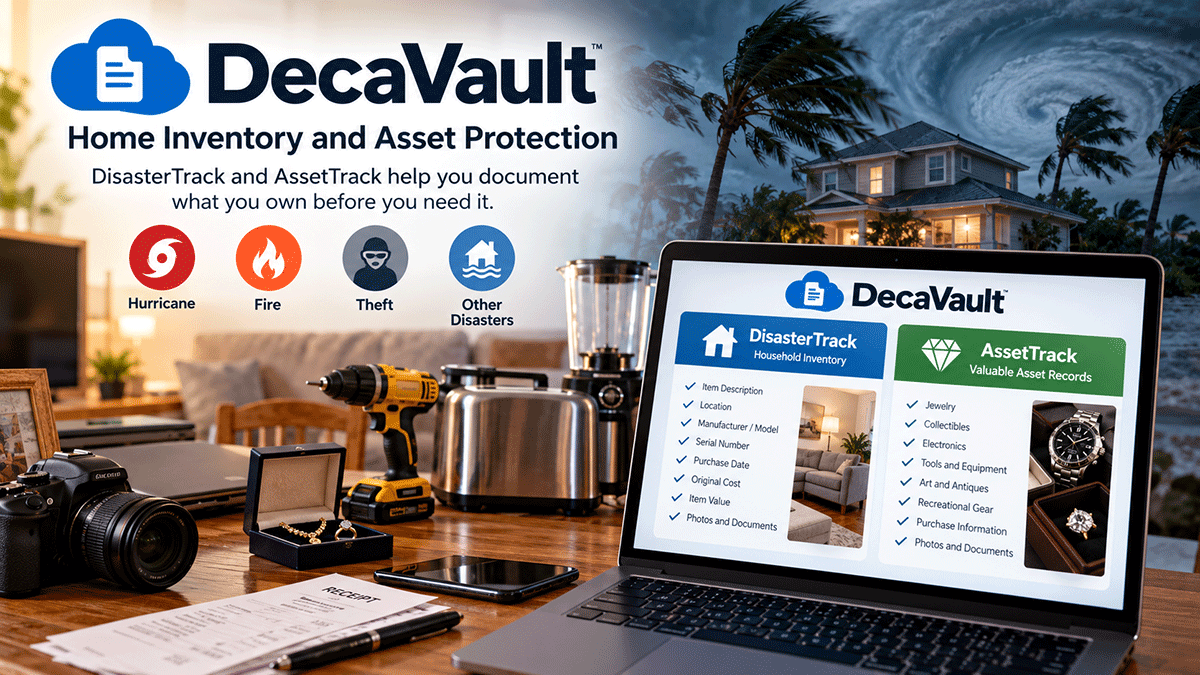
Home Inventory and Asset Protection with DecaVault DisasterTrack and AssetTrack
Most homeowners accumulate valuable possessions over many years, including furniture, electronics, appliances, tools, jewelry, collectibles, and other personal property. Unfortunately, few maintain a complete inventory of what they own, where it is located, or how much it originally cost.
When a hurricane, fire, theft, or other unexpected event occurs, reconstructing that information can become difficult and stressful.
DecaVault DisasterTrack and AssetTrack provide practical ways to organize household inventories and maintain important information about personal assets. Together, these applications help homeowners document their possessions before that information is urgently needed.
The Scenario: A Homeowner Preparing for the Unexpected
Consider a couple living in coastal North Carolina who have owned their home for fifteen years. During that time, they have accumulated furniture, appliances, computers, televisions, tools, outdoor equipment, jewelry, and family collectibles.
They also maintain a garage containing lawn equipment, power tools, and recreational gear.
Like many homeowners, they have homeowners insurance but have never created a comprehensive inventory of their belongings.
After experiencing a close call with a hurricane, they realize that documenting everything from memory following a major loss would be extremely difficult.
They decide to organize their household possessions and maintain better records of their valuable assets.
The Challenge: Knowing What You Own Before Something Happens
Homeowners frequently underestimate how much property they have accumulated and how difficult it would be to document those possessions after a disaster.
Common challenges include:
- Incomplete Inventories: No comprehensive record of furniture, electronics, appliances, tools, and other belongings.
- Missing Purchase Information: Receipts, purchase dates, and original costs are scattered across different locations.
- Unrecorded Serial Numbers: Important identifying information for electronics, appliances, and equipment has never been documented.
- Uncertain Values: Homeowners may not remember what individual items cost or what values were previously recorded.
- Valuable Collections: Jewelry, collectibles, and other significant assets may require more detailed individual records.
- Insurance Documentation: Preparing an accurate list of damaged or missing possessions can be difficult without an existing inventory.
The couple needs an organized system that makes it practical to document household possessions and maintain information about particularly valuable assets.
The Solution: DecaVault DisasterTrack and AssetTrack
DecaVault includes two complementary applications that address different aspects of personal property recordkeeping.
DisasterTrack focuses on documenting household possessions and maintaining inventory information that may be useful following a disaster, theft, or other loss.
AssetTrack provides a way to maintain records of individual assets and valuable possessions.
By using both applications, the homeowners can establish a more organized approach to protecting important information about their property.
1. Creating a Household Inventory with DisasterTrack
The couple begins by documenting the contents of their home using DisasterTrack.
They work through the house room by room, recording major possessions such as furniture, appliances, televisions, computers, and other household items.
For each item, they can maintain identifying information such as:
- Item description and location
- Manufacturer and model information
- Serial numbers, when applicable
- Purchase dates and original costs
- Recorded item values
Organizing this information in advance provides a useful reference if possessions are later damaged, destroyed, or stolen.
2. Documenting Items Throughout the Property
A home inventory should extend beyond the living room and bedrooms.
The couple also documents possessions stored in the garage, closets, attic, and outdoor storage areas.
These locations often contain valuable equipment and belongings that can easily be overlooked when preparing an inventory from memory.
By systematically recording possessions throughout the property, the homeowners develop a more complete picture of what they own.
3. Maintaining Valuable Asset Records with AssetTrack
Some possessions deserve more detailed individual attention.
The couple uses AssetTrack to maintain organized records of valuable assets such as jewelry, collectibles, specialized tools, and other significant personal property.
Maintaining these records separately helps distinguish important assets from the broader household inventory.
It also makes it easier to locate identifying and purchase information when reviewing personal property records.
4. Recording Purchase and Identification Information
Over time, purchase receipts can fade, disappear, or become separated from the items they document.
Likewise, model and serial numbers may be difficult to locate once equipment is installed or placed into regular use.
Recording available purchase and identification details while the information is accessible reduces dependence on memory later.
This is particularly useful for appliances, electronics, power tools, and other equipment with manufacturer identification numbers.
5. Maintaining Records as Possessions Change
A household inventory is most useful when it reflects what the homeowners currently own.
When the couple purchases a new television, replaces an appliance, or acquires another valuable possession, they can update their records.
Similarly, items that are sold, donated, or discarded can be reflected in their recordkeeping.
Making inventory updates part of ordinary household maintenance helps prevent the information from becoming outdated.
How These Records Can Help Following a Disaster
Suppose a hurricane causes significant damage to the couple’s home.
Instead of attempting to reconstruct years of purchases entirely from memory, they have an existing inventory containing descriptions, locations, purchase information, and identifying details for many of their possessions.
These records can provide a starting point when identifying damaged property and assembling information requested during an insurance claim.
However, maintaining an inventory does not guarantee insurance coverage, reimbursement, or acceptance of particular values. Actual coverage and documentation requirements depend on the insurance policy and insurer.
The principal benefit is having organized information available when it may be difficult or impossible to recreate.
The Results: Better Organization and Disaster Preparedness
By using DisasterTrack and AssetTrack together, the homeowners establish a more consistent approach to documenting their personal property.
The practical benefits include:
- More Complete Household Records: Possessions are documented systematically rather than relying on memory.
- Better Asset Organization: Valuable items can be tracked alongside the broader household inventory.
- Accessible Identification Information: Purchase details, model numbers, and serial numbers are easier to reference.
- Improved Disaster Preparedness: Existing records can help homeowners identify possessions affected by a loss.
- Less Administrative Effort: Information can be maintained in organized applications instead of scattered notes and spreadsheets.
- Ongoing Recordkeeping: Inventories can be updated as possessions are acquired, replaced, or removed.
This illustrative scenario demonstrates how DisasterTrack and AssetTrack can support household inventory management. It does not represent measured results from an actual customer.
Why Home Inventory Software Makes Sense
Creating a household inventory is one of those tasks that is easy to postpone because nothing appears urgent until a problem occurs.
Unfortunately, a major loss is often the worst time to begin documenting possessions.
DisasterTrack and AssetTrack give homeowners a practical reason to organize their information before an emergency.
They can also be useful for individuals who own valuable collections, maintain multiple storage locations, or simply want better records of their personal property.
For households in hurricane-prone regions, including coastal North Carolina, maintaining an inventory can be a particularly worthwhile part of disaster preparedness.
DisasterTrack and AssetTrack Are Included with DecaVault
DisasterTrack and AssetTrack are two of the ten tracking applications included with DecaVault, a Progressive Web App (PWA) designed to help individuals and small businesses organize important information.
For just $12.95 per month, subscribers receive access to all ten DecaVault applications rather than purchasing individual tracking tools separately.
In addition to household inventories and asset records, DecaVault includes applications for rental property information, personal loans, mileage records, prescriptions, medical appointments, and other personal recordkeeping needs.
Protect Your Household Records with DecaVault
You cannot prevent every hurricane, fire, theft, or unexpected loss, but you can prepare by documenting what you own.
DecaVault DisasterTrack and AssetTrack provide affordable tools for organizing household inventories, maintaining valuable asset information, and keeping important property records available for future reference.
Learn More About DecaVault, DisasterTrack, and AssetTrack →
Explore Our Software Solutions
Local Service Rep offers affordable software applications designed to simplify everyday business operations and personal recordkeeping.
- ServiceRep – Customer management, scheduling, job tracking, invoicing, and payments for service businesses.
- WorkOrder – Work order management for repair shops and businesses that service customer equipment.
- TimeBilling – Billable time tracking and invoicing for professionals and service providers.
- TimeClock – Employee time tracking for businesses with mobile and on-site workers.
- DecaVault – Ten tracking applications for organizing important personal and business records.
Developed by Rock Local Media Group, Inc.