
Tracking Employee Hours Across Construction Job Sites
Construction companies and specialty trade contractors frequently have employees working at different job sites throughout the week. Electricians, plumbers, HVAC technicians, carpenters, painters, and other skilled workers may begin their day at one location, move to another project, or work independently without reporting to a central office.
Accurately recording employee hours becomes more difficult when workers are spread across multiple job sites. Paper timesheets, handwritten job logs, and text messages may capture basic information, but they can leave contractors with incomplete records of where employees worked, what tasks they performed, and how much time they spent on each assignment.
The Business
Consider a small specialty contracting company with several employees working on residential and light commercial construction projects. The company handles multiple jobs simultaneously, with some employees working as part of a crew and others assigned to individual projects.
Its work may include new installations, renovations, repairs, equipment replacements, and general construction activities.
Employees may report directly to their assigned job sites rather than gathering at the company office each morning. Some projects last several days, while others require only a few hours of work.
The owner needs a dependable way to record employee hours and associate those hours with specific job sites and work activities.
The Challenge
The company previously relied on employees to submit handwritten timesheets or report their hours to a supervisor at the end of the day or week.
This created several problems:
- Employees sometimes forgot to record their starting or ending times.
- Timesheets did not consistently identify the job site where work was performed.
- Supervisors had difficulty verifying where employees were located when they started or finished work.
- Employees working on multiple projects sometimes combined their hours into a single entry.
- Work activities were not consistently identified in employee time records.
- Missed punches and incorrect entries required additional communication and manual corrections.
- Preparing time records for payroll required collecting information from several employees and supervisors.
- The owner had limited visibility into which employees were currently clocked in.
The company needed a straightforward employee timekeeping system that could support multiple construction job sites without requiring dedicated time-clock equipment at every location.
Using TimeClock
The contractor begins using TimeClock to organize employee time records around its active job sites and common work activities.
Each active construction project is added as a work location. Where appropriate, the company can configure coordinates and establish an allowed clocking radius for the job site.
The company also creates tasks representing common construction activities, including:
- Site preparation
- Installation
- Repairs
- Equipment replacement
- Framing and carpentry
- Electrical work
- Plumbing work
- Painting and finishing
- Cleanup
- General labor
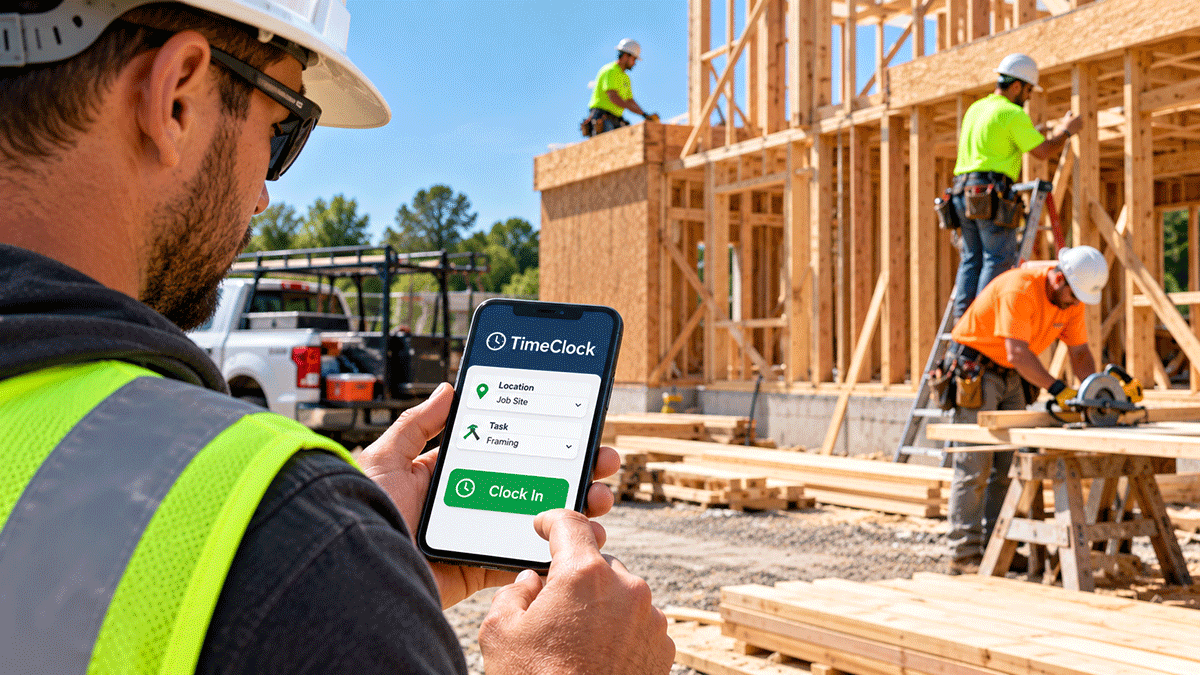
Each employee receives an individual account and unique PIN. Employees authorized for mobile clocking can access TimeClock from their smartphones when beginning or ending work at an assigned job site.
Clocking In at the Job Site
When an employee arrives at a construction site, the employee selects the appropriate work location and task before clocking in.
TimeClock records the punch time along with available location information, including the reported coordinates, location accuracy, and distance from the configured work location.
This provides the contractor with additional information about where the employee was located when the punch occurred.
When an allowed clocking radius has been configured, the company can use location verification to help ensure employees are clocking in or out at the appropriate job site.
TimeClock records location information when employees clock in or out. It does not continuously track employee movements or monitor their activities throughout the workday.
At the end of the assignment, the employee clocks out. The completed time entry provides a record of:
- The employee
- The selected construction job site
- The assigned work task
- The clock-in time
- The clock-out time
- The total recorded hours
- Available punch-time location details
Tracking Labor Across Multiple Projects
Small contractors frequently manage several projects at the same time. One crew may be completing an installation at a commercial property while another handles renovation work at a residential location.
TimeClock allows employees to associate their recorded hours with the appropriate work location and task.
For example, an employee might spend the morning performing installation work at one project and the afternoon completing repairs at another.
By clocking out of the first assignment and creating a new time entry for the second, the employee can maintain separate records for each location and activity.
This gives the contractor a clearer picture of how employee hours are distributed across different projects.
TimeClock is an employee timekeeping application, not a construction project management or job-costing system. However, its location-based and task-based time records can provide useful information for reviewing labor hours associated with individual projects.
Supporting Mobile Workers and Shared Clocking
Construction companies may have employees who report directly to job sites and others who begin their workday at a company office, warehouse, or equipment yard.
TimeClock supports different clocking methods within the same company.
Employees authorized for mobile clocking can use their smartphones at assigned job sites.
Employees who report to a central facility can use a shared tablet configured as a time-clock kiosk.
Mobile clocking permissions can be enabled individually, allowing the company to determine which employees require access from their phones.
This flexibility allows the contractor to support different working arrangements without purchasing specialized time-clock hardware for every project.
Reviewing Employee Hours and Work Activities
The owner or an authorized Time Manager can review employee punches over a selected date range.
Each recorded entry provides information about the employee, selected work location, task, and recorded hours.
This helps managers review employee time associated with different construction projects and work activities.
The employee list also indicates whether each employee is currently punched in or out.
For contractors managing employees across several job sites, this provides a convenient way to identify workers who may have forgotten to complete a punch.
It does not provide continuous employee location monitoring or real-time job-site tracking.
Handling Missed Punches and Time Corrections
Construction employees sometimes forget to clock out, experience connectivity problems, or need to correct an inaccurate time entry.
Instead of relying on handwritten changes or undocumented adjustments, an authorized manager can correct a recorded entry and provide a reason for the change.
Managers can also create documented manual entries when an employee was unable to record time normally.
Keeping explanations with corrections provides a clearer administrative record and helps the company maintain more consistent employee timekeeping procedures.
Preparing Employee Time Records for Payroll
At the end of the pay period, the contractor can review employee time records and prepare the information needed for payroll.
TimeClock supports printable reports and CSV exports. Businesses using a compatible QuickBooks workflow can also generate an IIF export.
These options reduce the need to collect handwritten timesheets, reconcile text messages, and manually enter employee hours from multiple sources.
TimeClock does not calculate wages, process payroll, or manage construction project accounting. Its purpose is to provide organized employee time records that can support the contractor’s existing payroll and administrative procedures.
The Practical Benefits
By using TimeClock, the construction or specialty contracting company can:
- Maintain employee time records in one system.
- Associate employee hours with specific construction job sites.
- Identify the tasks employees performed during recorded work periods.
- Record available location information when employees clock in and out.
- Support employees working across multiple projects.
- Provide mobile clocking for authorized employees.
- Use shared-tablet clocking at a company office or equipment yard.
- Review current employee clock status.
- Document missed punches and time corrections.
- Review labor hours associated with individual locations and tasks.
- Print or export employee time records for payroll preparation.
- Avoid purchasing dedicated time-clock equipment for every job site.
A Simpler Way to Manage Construction Employee Time
Construction companies and specialty trade contractors depend on employees who work at different locations, often without reporting to a central office. Maintaining accurate time records becomes more challenging when workers move between projects and perform different activities throughout the week.
TimeClock provides small contractors with a practical way to organize employee hours around job sites, tasks, and documented clock-in and clock-out records.
With mobile clocking, optional location verification, shared-tablet support, and exportable time records, contractors can reduce the administrative work involved in collecting employee hours while maintaining clearer records of where and when employees worked.
Start Your Free 14-Day TimeClock Trial
Explore Our Software Solutions
Local Service Rep offers practical, affordable software designed to simplify everyday business operations. Explore our solutions:
- ServiceRep – Customer and service management software for small businesses.
- WorkOrder – Create, assign, and track service work orders.
- TimeBilling – Track billable time and prepare customer invoices.
- TimeClock – Employee time tracking with location verification and reporting.
- DecaVault – Secure document storage and organization.
Developed by Rock Local Media Group, Inc.